
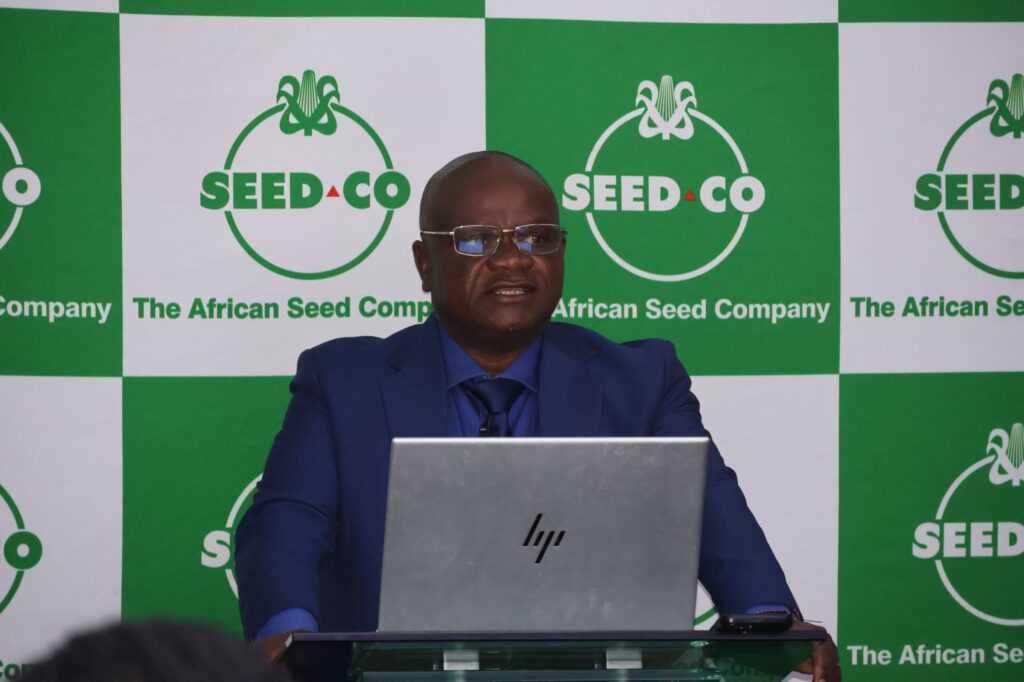
Harare — Seed Co Group closed its financial year to 31 March 2026 with profit at its international arm up 130%, and executives used Monday’s results briefing to lay out an aggressive build-out of processing capacity, irrigation infrastructure and a deep varietal pipeline that management says will carry the pan-African seed producer toward a new medium-term profitability target.
Group Chief Executive Officer Morgan Nzwere told investors that Seed Co International Limited (SCI), the group’s regional operating unit, delivered revenue of $161.3 million, up 30% from $124.3 million a year earlier, while profit after tax jumped to $13.1 million from $5.7 million. Gross margin expanded to 53% from 50%, and operating profit nearly doubled to $28.8 million.
But the headline for growth-watchers was the company’s forward guidance: Seed Co International is now targeting Core EBITDA margins of at least 20%, up from an EBITDA margin that has climbed from single digits in FY19 to 23.6% in FY26, and PAT margins of at least 8%, which management says will be underpinned by continued product-mix improvement and operating leverage.
Revenue at the international unit has grown from $64 million to $161.3 million over the period — a 12% compound annual growth rate — and executives want that trajectory to continue.
Tanzania Plant Nears Completion, Zambia Warehouse Next
Much of the near-term growth story is physical infrastructure. A new factory in Tanzania and a depot warehouse in Zambia are both scheduled to be commissioned in September 2026, additions the company frames as central to closing a persistent gap between demand and supply.
“Regional supply chain constraints” that left the group unable to fully meet demand were flagged as a key operating challenge, alongside a forecast Super El Niño event threatening Southern African rainfall in the 2026/27 season.
To offset that risk, Seed Co is leaning on geographic diversification — it expects East Africa to receive comparatively better rains — and on a broader infrastructure push that includes modular seed driers, expanded warehousing and irrigation.
The company reported that 70% of group production is now under irrigation, including 40% in Malawi, alongside a newly commissioned colour sorter in Zimbabwe and improved efficiency at the country’s artificial grain driers.
Capital expenditure at the international business was $5.3 million for the year, down from $7.4 million as the Tanzania project neared completion, while the domestically listed Seed Co Limited spent $3.6 million, a third of it on research and development.
New Varieties Aimed at Climate Resilience and Import Substitution
On the product side, the group described an active development pipeline spanning white and yellow maize, wheat, soybean, sorghum and rice, with new breeding material carrying improved cob-rot tolerance.
Specific launches flagged for coming seasons include white and yellow maize varieties for Zambia (SC449, SC561, SC614, SC710) aimed at portfolio renewal and the growing yellow-maize segment; a new maize variety for Nigeria (SC681) supporting West African expansion; a rice variety (SC xP107) targeting a key West African segment; a soybean variety for Kenya (SC SZ01) aimed at new-market development; and a market-gap yellow maize variety for Zimbabwe (SC522).
A standout is the planned commercial launch of a white wheat variety in Zimbabwe, which the company says is designed explicitly to meet rising domestic demand and reduce wheat imports — an import-substitution play tied directly to national food-security policy.
Disease and pest tolerance work is concentrated on cob rot, fall armyworm, maize streak virus and maize necrotic lethal disease, supported by a partnership with French agri-genetics group Limagrain. Breeding capacity has been expanded in Zambia, Kenya and Tanzania.
Expansion Markets and Retail Push
Beyond its established “mature” markets — Zambia, Malawi and Botswana, which contributed 50% of FY26 volume — and “growing” markets Tanzania and Kenya (40% of volume, with Tanzania leading growth), Seed Co named Angola and Uganda as pipeline markets with future potential, alongside early sales activity already under way in Mozambique.
The group is also building out its own retail footprint, expanding to 21 points of sale in Zimbabwe to drive direct cash sales and reduce exposure to credit risk — a response to volume declines in that market, where deliberate credit-risk management cut Zimbabwe volumes 40% year-on-year even as open-market sales grew.
Policy Tailwinds
Management pointed to several external developments it expects to support growth, including the planned removal of seed subsidies in Tanzania this year, which it characterised as a positive shift toward market-based demand, and ongoing IMF engagement in Malawi and Zimbabwe. Upcoming elections in Zambia are also expected to spur seed demand, a pattern the company has seen in prior election cycles.
Overheads across the group were reduced 17% at the parent company level, reflecting continued cost discipline even as the international unit’s operating expenses rose 17% to $50 million to support the expansion agenda.
The group declared a total dividend of $7.9 million for the year — $6.2 million from Seed Co International, up 118% per share, and $1.7 million from Seed Co Limited, down 25% in line with a decline in the parent company’s standalone profit, which fell to $8 million after more conservative credit extension curtailed export and public-sector sales.