
By Conrad Mwanawashe
The latest half-year results to December 31 2025, from Simbisa Brands Limited reveal a company that is not simply maintaining its market position in challenging environments but is actively enhancing its competitive edge.
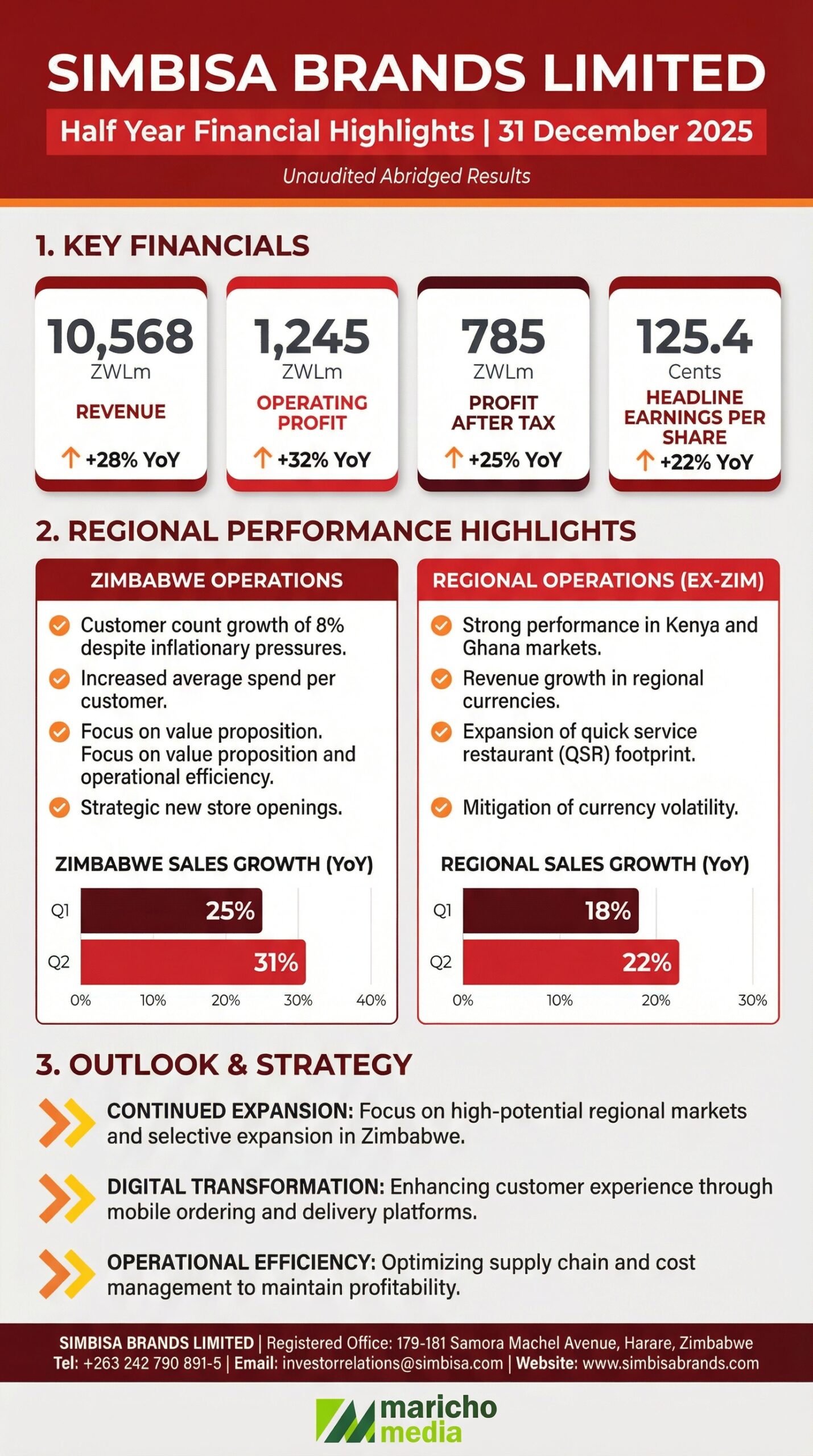
In a landscape marked by tax increases, liquidity issues, and cautious consumer behaviour, the quick-service restaurant group achieved a notable 16% revenue growth, reaching US$182.8 million, alongside a 76% increase in profit before tax, to US$20.4 million.
Growth at the top line was primarily driven by volume. The company reported a 10% increase in customer counts across the group, a vital indicator in the consumer sector. Additionally, a 6% rise in real average spending suggests that effective promotions and expanded delivery options are optimising customer baskets without sacrificing margins.
This operational efficiency is highlighted by a 27% increase in operating profit before depreciation and amortization, significantly outpacing revenue growth. Such performance in inflationary and tax-heavy markets points to effective cost management and procurement strategies.
Zimbabwe continues to be the backbone of earnings,
with domestic revenue rising by 19%,
buoyed by 27.2 million customers over six months.
The impressive 74% growth in delivery orders signifies a fundamental shift in consumer preferences, enhancing convenience and customer loyalty.
Despite challenges like the fast-food tax and power outages, Simbisa’s local operating margins expanded. The ability to maintain these margins, even while absorbing some gross profit to protect consumers from price increases, showcases the company’s pricing intelligence.
In Kenya, despite political unrest and weakened consumer confidence, volumes increased by 12%. Although average spending in US dollars fell by 4% due to aggressive promotions, overall revenue still grew by 8%, with operating margins remaining stable. This resilience amidst promotional pressures indicates operational flexibility rather than desperation.
Eswatini, albeit smaller in scale, demonstrated the fastest revenue growth at 23% year-on-year, driven by significant increases in both volumes and spending. While currency appreciation helped mitigate inflation, disposable incomes remained tight. The dual growth in ticket sizes and customer traffic in this environment highlights Simbisa’s strong brand presence and consistent execution.
The balance sheet is equally impressive, with total assets rising to US$227.7 million and equity increasing to US$110.5 million. The company generated US$36.5 million from operations, yielding an exceptional 115% operating profit-to-cash conversion ratio. Even after making US$18.9 million in investments for expansion and refurbishments, Simbisa still reported a net cash increase, providing management with strategic flexibility as competitors face capital constraints.
Capital allocation has been strategic, with the addition of 14 new stores and the completion of 21 refurbishments over the year. The ambitious pipeline includes plans for 31 new stores by the end of the year and another 21 refurbishments, all while implementing solar power initiatives, digital upgrades, and supplier negotiations to safeguard margin sustainability.
Earnings per share doubled to 2.80 US cents, and the interim dividend increased by 51% to 0.934 US cents per share. This growth in payouts and capital expenditures reflects confidence in future cash flows and underscores management’s belief that growth and shareholder returns can coexist.
The decentralised, brand-focused operating model employed in Zimbabwe and Kenya is the underlying engine driving these results. By enhancing accountability at the brand level, Simbisa has improved cost visibility and accelerated response times in volatile markets, a crucial factor in environments with rapid fiscal and tax adjustments.
While risks remain—such as impending fiscal tightening in Zimbabwe and unresolved socio-political issues in Kenya—the company has shown that its value-driven approach, delivery expansion, and operational discipline can mitigate macroeconomic challenges.
Simbisa is evolving into a regional consumer powerhouse rather than just a domestic fast-food chain. With 340 outlets in Zimbabwe, 259 in Kenya, and 130 franchised locations across markets like the DRC, Zambia, and Ghana, the benefits of scale are becoming increasingly pronounced. If management continues to drive volume growth while maintaining cost discipline, margin expansion is likely to persist even durin