
By Conrad Mwanawashe recently in Mvurwi
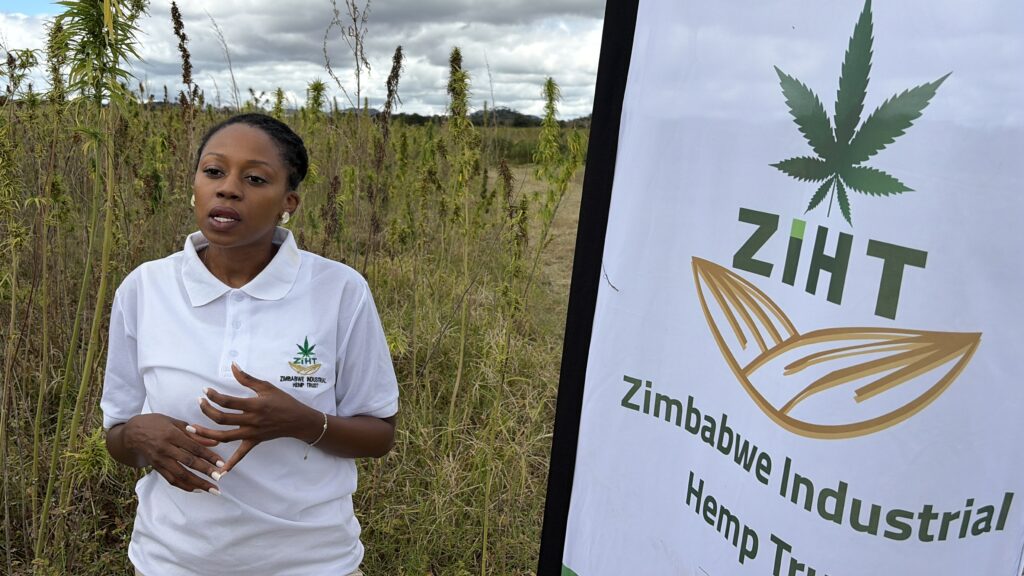
The Zimbabwe Industrial Hemp Trust (ZIHT) has established the country’s first 10-hectare commercial hemp trial, not as a showpiece, but as a working laboratory for an industry still finding its footing.
What stands out is not merely the crop itself, but the deliberate insistence on research as the foundation of everything that follows. As ZIHT Founder and CEO, Dr Zorodzai Maroveke makes clear, the country is not rushing into hemp production on assumption or global hype, but building from evidence, step by step, to avoid costly missteps in an unfamiliar sector.
Zimbabwe enters the hemp space without localised data. There is no established baseline on yields, input costs, processing efficiencies or market dynamics under Zimbabwean conditions. This absence of data is precisely what the Trust is addressing.
Research is not being treated as an academic exercise, but as the core instrument for decision-making. Without it, farmers risk entering a value chain they do not understand, financiers cannot assess risk, and policymakers lack the grounding to support the sector meaningfully.
The Trust’s research is structured around four interconnected pillars:
agriculture, industrial processing, business development and sustainability.
In the field, agricultural research is unfolding through layered trials. Large-scale commercial plots provide insight into viability at scale, while scientific trials under the Ministry of Agriculture refine technical parameters such as planting regimes and crop performance.
Alongside these are master farmer trials, where small to medium-scale growers generate practical data from one to five hectares. These multiple streams are not isolated; they converge into a national dataset that will inform a tailored agricultural strategy.
Seed variety experiments further strengthen this base, ensuring that the crop is adapted to local climatic and soil conditions rather than imported assumptions.
“They collect their own data and we put that together. This is how we are going to develop an agriculture strategy,” said Dr Maroveke.
She was speaking to Maricho on the sidelines of a field day held ta Disi Fram in Mvurwi.
Beyond the field, the Trust is mapping industrial processing pathways. Ten value chains have been identified as immediately viable, including construction materials, textiles, paper packaging, bioplastics, food and animal feed.
This approach recognises that production alone is insufficient; value lies in processing and product development. Research is therefore directed at understanding how to reduce production and processing costs while maintaining competitiveness, particularly against established crops such as tobacco and cotton.
Business development forms the third pillar, and here the emphasis is on feasibility and bankability. ZIHT is working to translate raw agricultural and processing data into practical models that investors and financial institutions can trust.
Dr Maroveke underscores that land, water and enthusiasm are not enough; profitability depends on clear knowledge of input costs, yields, market prices and processing margins. By developing comprehensive manuals for farmers and financial frameworks for lenders, the research aims to convert hemp from a speculative crop into a structured industry.
“The R&D we are conducting will give us proof of concept.
It will give us data. It will give us information.
It will leapfrog us to de-risk an infant industry to be bankable.”
Sustainability anchors the entire programme. The vision extends beyond profit to social inclusion, environmental stewardship and long-term sector resilience. By integrating smallholder farmers into trials and designing scalable models, the Trust is positioning hemp as a crop that can support rural livelihoods while contributing to broader economic transformation.
What emerges from this work is a disciplined attempt to de-risk an infant industry. Research is being used to generate proof of concept, close knowledge gaps and build confidence across the value chain. In a country seeking new agricultural frontiers, the Zimbabwe Industrial Hemp Trust is demonstrating that sustainable growth begins not in the field, but in the data that shapes it.
Feedback: cmwanawashe@marichomedia.com