




By Conrad Mwanawashe
Government has stepped up efforts to unlock the economic potential of Zimbabwe’s fisheries and aquaculture sector, positioning the industry as a key pillar of the country’s emerging blue economy.
This came as policymakers, researchers, development partners and farmers gathered in Harare for the inaugural National Fisheries and Aquaculture Sector Symposium, a forum aimed at strengthening research collaboration and shaping policies to accelerate growth in the sector.
Opening the symposium, Permanent Secretary in the Ministry of Lands, Agriculture, Fisheries, Water and Rural Development Professor Obert Jiri, in a speech read on his behalf, said the meeting marked an important step in aligning research, policy and industry participation to drive sustainable fisheries and aquaculture development.
“We gather with a shared purpose: to harness the power of research and collaboration to unlock the immense potential of Zimbabwe’s blue economy,” he said.
Professor Jiri said the symposium forms part of the implementation framework of the Agriculture Food Systems and Rural Transformation Strategy 2 (AFSRTS 2) covering the period 2026–2030, which is designed to guide the country towards attaining upper middle-income status by the end of the decade.
He said that government expanded the mandate of the Ministry in 2021 to formally incorporate fisheries, recognising the sector’s growing importance to food security, economic development and rural livelihoods.
Zimbabwe’s fisheries industry, however, faces a number of structural challenges that have limited its growth. Professor Jiri said national demand for fish protein continues to rise while capture fisheries are increasingly under pressure from illegal and unsustainable fishing practices.
He said kapenta production, which reached about 27 000 metric tonnes annually in the 1990s, has declined significantly to around 5 000 tonnes due to illegal and unregulated fishing.
As a result, Government is prioritising aquaculture as a sustainable alternative to increase domestic fish supply and reduce pressure on natural water bodies.
“Our national strategy acknowledges that aquaculture presents a sustainable and strategic alternative to enhance the resilience of our communities,” Professor Jiri said.
He added that interest in fish farming has grown in recent years, driven by technological advances and Government initiatives such as the Presidential Community Fisheries Scheme under the Rural Development 8.0 programme.
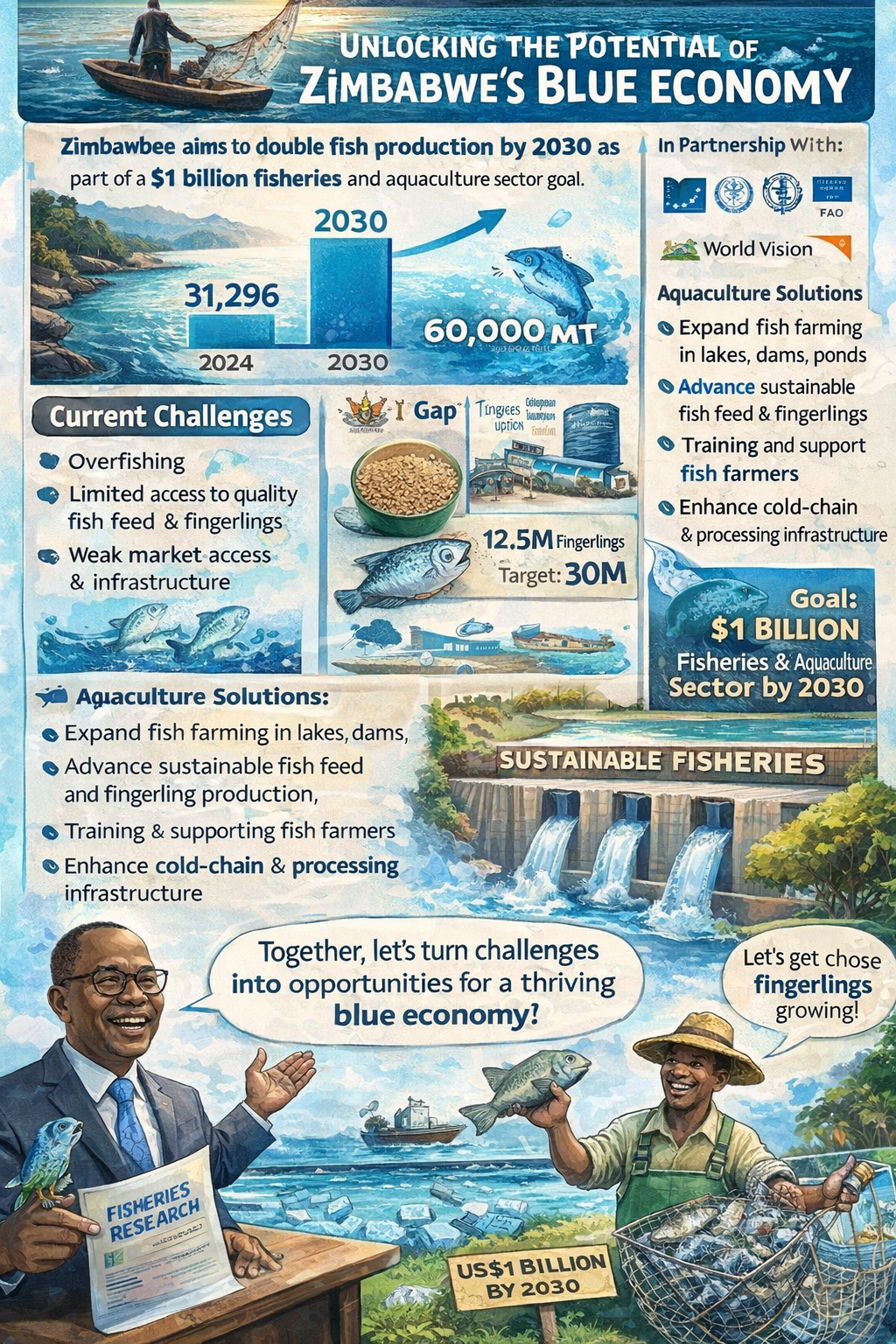
Despite this momentum, the sector still faces key constraints including limited access to quality fingerlings and fish feed, weak infrastructure and the need for stronger regulatory and research frameworks.
Professor Jiri said Zimbabwe currently produces approximately 12.5 million fingerlings annually against a national target of 30 million required to support expanded fish farming.
He said women and youth were increasingly participating in aquaculture, accounting for roughly 30 percent of fish farmers across provinces, highlighting the sector’s potential as an inclusive rural enterprise.

The symposium brought together researchers, policymakers and private sector players to present research findings and identify solutions to the industry’s main constraints, including inefficient production systems, limited access to technology and weak market competitiveness.
Food and Agriculture Organisation of the United Nations (FAO) Subregional Coordinator for Southern Africa, Dr Patrice Talla said the symposium was expected to explore themes spanning aquaculture production, fish breeding and genetics, fish nutrition, aquatic animal health, environmental sustainability, capture fisheries, and market development, topics that reflect both the complexity and the promise of Zimbabwe’s fisheries and aquaculture sector.
FAO’s FISH4ACP programme, supported by the EU and BMZ, has played a transformative role in reshaping the tilapia value chain in Zimbabwe. Together with the Government and sector partners, we have:
- Conducted a comprehensive tilapia value chain analysis, identifying strategic priorities.
- Supported the development of environmental guidelines and biosecurity frameworks for small-scale fish farmers.
- Scaled up the Aquaculture Business School (ABS) to strengthen farmer business and technical skills.
- Facilitated market development initiatives, consumer awareness, and new product branding.
- Strengthened research, sector monitoring, and national data systems—including the National Aquaculture Frame Survey.
“These investments are already yielding visible results: improved hatchery practices, stronger farmer associations, more organised value chains, and an expanding portfolio of local research that will be showcased during this Symposium,” said Dr Talla, in a speech read on his behalf.
“FAO remains steadfast in its commitment to supporting Zimbabwe, strengthening policy, building technical capacity, enhancing data systems, and mobilising resources for sector development. We value our partnership with the Government, Research institutions, farmer organisations, and the private sector,” he added.
According to organisers, the meeting also seeks to align research outputs with practical solutions for farmers and industry players.
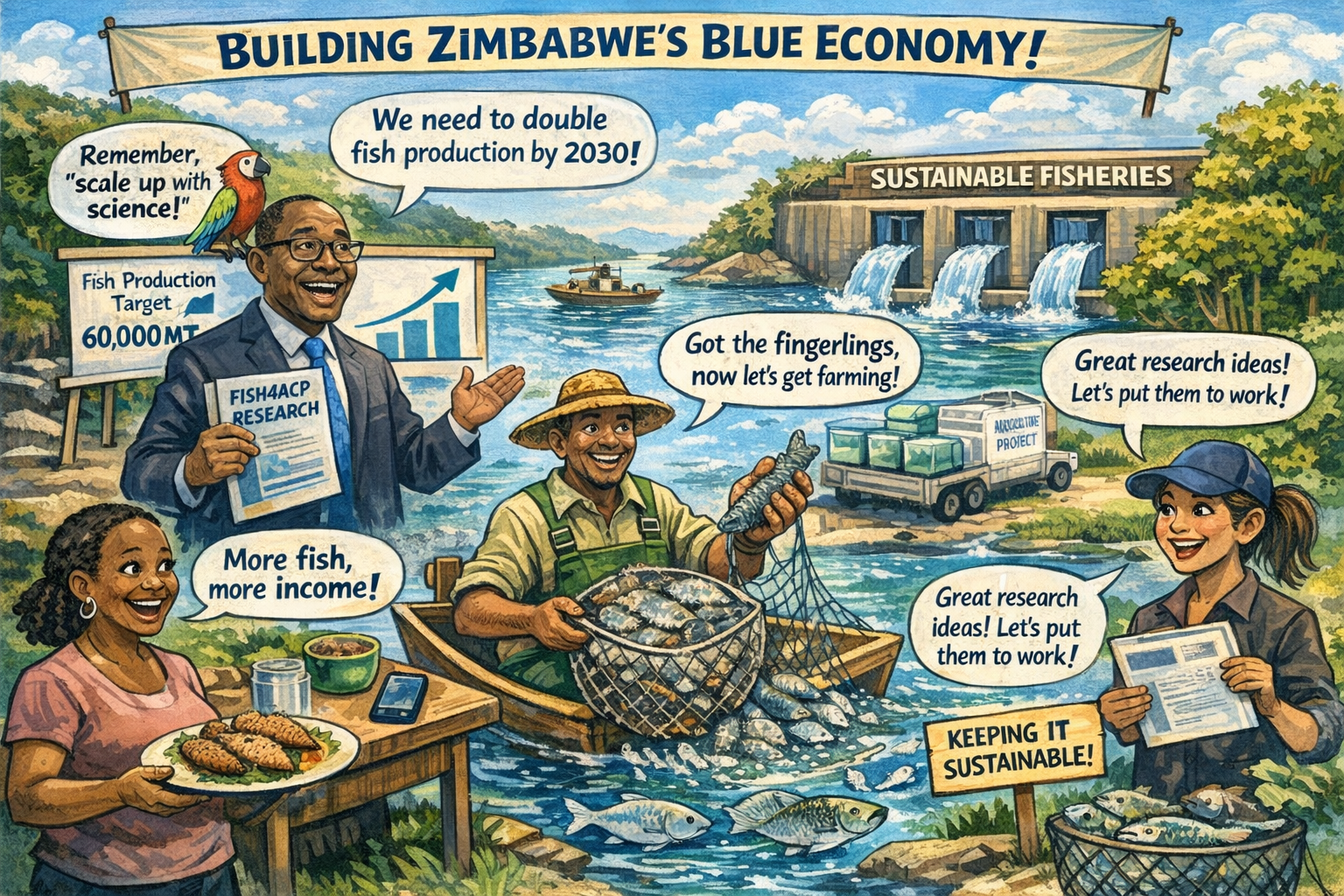
Government has set an ambitious target to increase national fish production from about 31 296 metric tonnes in 2024 to 60 000 metric tonnes by 2030 as part of the broader blue economy strategy.
Professor Jiri said achieving the target will require stronger partnerships between government, universities, development partners and the private sector.
“The contributions from Chinhoyi University of Technology, the University of Zimbabwe, Lupane State University, the University of Johannesburg, the University of Botswana, and the University of KwaZulu-Natal, alongside government research stations, demonstrate deep regional and national engagement in solving fisheries and aquaculture challenges,” said Dr Talla.