



In line with our objective to deliver evidence-based content, we publish here a conversation Maricho Media (MM), held with Mr George Mashababe (GM), Director General of the Civil Aviation Authority of Zimbabwe (CAAZ) on Aviation and Climate.
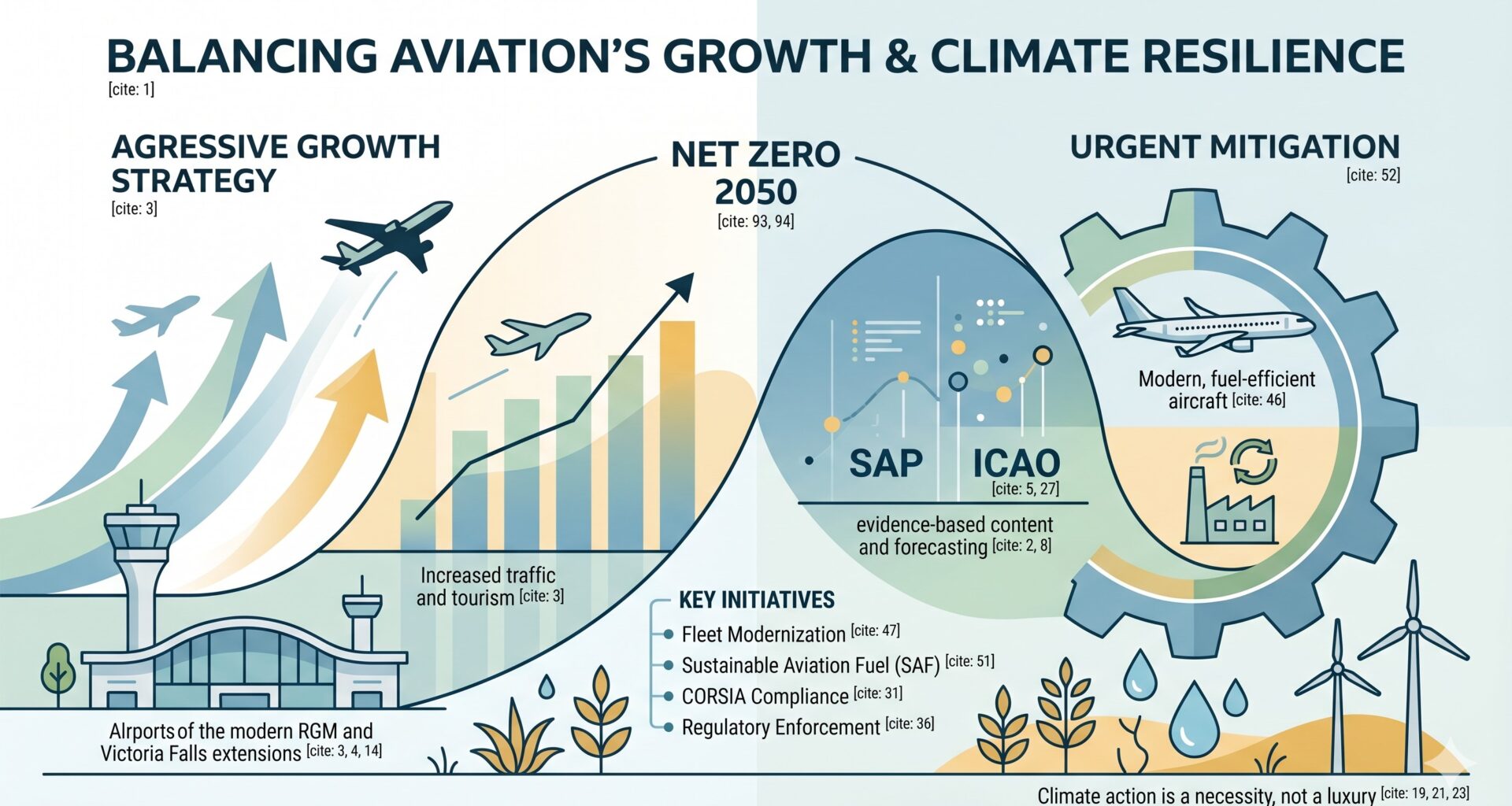
(MM): The Growth Paradox: Zimbabwe’s “Open Skies” policy and airport expansions (like RGM and Victoria Falls) are designed to increase traffic and tourism revenue. How do you reconcile this aggressive growth strategy with the urgent global need to reduce aviation emissions?
GM: Zimbabwe addresses this through its State Action Plan for the Reduction of CO2 Emissions from International Aviation (SAP). The SAP begins by accepting that air traffic will continue to grow. Instead of trying to stop growth, it focuses on managing it in a smarter way.
The strategy uses data to forecast future emissions and then identifies specific, practical measures to reduce them. This means climate goals are built directly into the growth plan, ensuring they are realistic. The SAP provides a clear guide for the industry, improving operational efficiency, and managing demand growth responsibly—to ensure this connectivity can continue within a decarbonized future.
(MM): Tourism’s Carbon Footprint: Tourism contributes significantly to Zimbabwe’s GDP, yet long-haul flights are the most carbon-intensive part of a tourist’s journey. Is the industry worried that “flight shaming” or carbon taxes in source markets (like Europe) will eventually hurt Zimbabwe’s tourism numbers?
 GM: Not really, the recent designation of Zimbabwe as the World’s Best Country to Visit by Forbes in 2025 is a powerful testament to the global confidence in our nation’s tourism value chain. This recognition directly validates the strategic investments in our aviation infrastructure—such as the expansion of RGM International and Victoria Falls airports—which provide the vital connectivity that makes this prestigious accolade possible.
This kind of global publicity is essential, as it showcases not just our natural wonders, but also our commitment to a sustainable future. It highlights that our national strategy is working: we are successfully enhancing accessibility and growth while actively managing our environmental footprint through frameworks like the SAP. The world is recognizing Zimbabwe as a destination where exceptional travel experiences and responsible, forward-looking development are taking flight together.
(MM): Economic Trade-offs: For a developing nation like Zimbabwe, is it realistic to prioritise decarbonisation when the immediate priority is reviving the national carrier and ensuring connectivity? Is climate action seen as a luxury or a necessity here?
GM: For Zimbabwe, decarbonization is part of development. Our National Development Strategies (NDS 1&2) mandate sustainable development. This is urgent. Zimbabwe has not been spared by climate change, as shown by disasters such as Cyclone Idai and persistent droughts. Climate action is not a luxury but a necessity as we work towards a sustainable aviation future. Building climate resilience is a must.
Therefore, our SAP applies this, it shows how we pursue growth while integrating mitigation, ensuring development is both sustainable and resilient.
(MM): NDC Integration: Specifically, how does the aviation sector feature in Zimbabwe’s latest Nationally Determined Contributions (NDCs) under the Paris Agreement? Is there a calculated target for aviation emissions, or is the sector currently exempt?
GM: International aviation emissions fall under ICAO’s global framework, not Zimbabwe’s NDC. Domestic aviation emissions are included within the broader Transport/Energy sectors of the NDC. This reflects our two-track approach: international emissions are managed through our dedicated State Action Plan under ICAO, while domestic emissions are addressed as part of our integrated national climate strategy. Both tracks demonstrate our commitment to reducing aviation’s footprint.
(MM): CORSIA Compliance: As the International Civil Aviation Organisation (ICAO) moves deeper into the implementation of CORSIA (Carbon Offsetting and Reduction Scheme for International Aviation), is Zimbabwe prepared for the financial implications of offsetting emissions, or will this drive-up ticket prices for local travellers?
GM: Zimbabwe is preparing for CORSIA by prioritizing direct emissions reduction through our State Action Plan. This includes measures like fleet modernization and operational efficiency to lower our carbon footprint, thereby minimizing the volume of offsets required. While airlines may face new costs, our proactive strategy aims to contain these expenses and limit any potential impact on ticket prices for local travellers. We are engaged with ICAO to ensure implementation supports both our environmental responsibilities and the affordability of air travel.
(MM): Enforcement vs. Encouragement: Does the Civil Aviation Authority of Zimbabwe (CAAZ) currently have the legal teeth to enforce environmental standards, or are current sustainability measures purely voluntary for airlines operating here?
GM: Zimbabwe has domesticated ICAO Annex 16 standards into national law, empowering CAAZ with enforcement authority under the Civil Aviation Act. Critically, the State Action Plan (SAP) was developed collaboratively by a National Action Plan Team representing all aviation sectors, ensuring industry ownership of its sustainability measures. This alignment is strengthened as airlines pursue their own ESG goals, which dovetail with the SAP. This shared commitment facilitates compliance, making the process cooperative rather than punitive.
(MM): The “Old Fleet” Problem: Older aircraft burn significantly more fuel. With financial constraints limiting the ability of local airlines to purchase modern, fuel-efficient planes, does Zimbabwe risk becoming a dumping ground for older, higher-emitting aircraft that are being phased out of Europe and Asia?
GM: Under the wise leadership of His Excellency President Dr. E.D. Mnangagwa, and guided by the “Zimbabwe is Open for Business” mantra, the Government has implemented pivotal reforms to remove investment barriers and enhance the ease of doing business. A landmark achievement in aviation is the recent ratification of the Aircraft Protocol of the Cape Town Convention.
This critical move significantly reduces financiers’ risk, thereby making it easier and more affordable for local operators to access newer, more fuel-efficient aircraft. This directly supports our sustainability goals by modernizing the fleet. Furthermore, specific incentives—such as the deferral of VAT on aircraft imports—serve as effective mechanisms for introducing modern, efficient aviation technology. These strategic policy actions demonstrate how national economic policy is actively enabling the aviation industry’s transition toward a more sustainable and competitive future.
(MM): The SAF Opportunity: Zimbabwe has a robust sugar and ethanol industry (e.g., Green Fuel). Is there any serious discussion or feasibility study regarding producing Sustainable Aviation Fuel (SAF) locally, or is the infrastructure gap too wide to bridge by 2030?
GM: The development and deployment of Sustainable Aviation Fuel (SAF) is indeed the cornerstone of our State Action Plan, projected to deliver 86% of our expected emissions savings by 2050. Significant progress has been made in implementing this critical measure. In 2023, we successfully concluded a comprehensive national SAF feasibility study. The final report was formally received by the Deputy Minister of Transport and Infrastructural Development, Honourable J.K. Sacco (MP), on the sidelines of the Third ICAO Conference on Aviation and Alternative Fuels (CAAF3).
The study identified 14 potential local feedstocks, with Alcohol-to-Jet (ATJ) from bioethanol and Hydro-processed Esters and Fatty Acids (HEFA) from Jatropha and other oilseeds emerging as the most promising pathways.
Notably, this was one of the few feasibility studies globally to yield a positive assessment under ICAO’s methodology. Building on this strong foundation, Zimbabwe has secured support from the UK Government through the ICAO Environment Fund to conduct a pioneering Business Implementation Study. This next-phase study will take us from potential to project, focusing on commercial viability and investment frameworks.
We are proud to position Zimbabwe as a global forerunner in this novel field, undertaking one of the first studies of its kind. The Business Implementation Study is currently underway, and we are optimistic that its positive findings will catalyse the tangible advancement of a domestic SAF value chain, turning our strategic vision into reality.
(MM): Infrastructure Resilience: Climate change isn’t just about emissions; it’s about adaptation. With rising average temperatures in Zimbabwe, are we seeing issues with “density altitude” (thinner air) affecting take-off weights or cargo capacity at high-altitude airports like Harare or Bulawayo?
GM: Indeed, the IPCC AR6 report confirms the 2011-2020 decade was 1.09°C warmer than pre-industrial levels. Zimbabwean aviation is committed to contributing to the Paris Agreement’s temperature goals. Technically, even with the projected warming, locations such as Zimbabwe will remain well within the vast operational envelope of modern aircraft, a capability proven daily in regions like the Middle Eastern hubs where aircraft continue to operate safely and efficiently.
Looking forward, the industry’s proactive work on performance optimization focuses on adapting to the operational and economic impacts of a warmer climate—managing challenges like reduced payload on very hot days and increased turbulence—to ensure ongoing safety, efficiency, and comfort.
(MM): The Equity Argument: Africa contributes less than 4% of global carbon emissions but bears the brunt of the impact. Do you believe global aviation regulations fairly account for Zimbabwe’s need to develop, or are one-size-fits-all climate rules hindering the growth of African aviation?
GM: The principle of Common but Differentiated Responsibilities and Respective Capabilities (CBDR-RC) under the Paris Agreement is central to the global climate governance framework. This principle is directly reflected in the approach of the International Civil Aviation Organization (ICAO). Its climate strategy encourages States to implement measures in light of their own national circumstances and capabilities. This acknowledges that the path to sustainable aviation will vary, considering different levels of development, infrastructure, and fleet composition.
Therefore, while the sector’s collective goal aligns with the Paris Agreement’s objectives, the strategies and implementation timelines are shaped by this equitable principle. The technical resilience of aircraft you noted is a universal enabler, but the pace and focus of operational adaptations, fleet modernization, and investment in new technologies will rightly differ across states, with support from international cooperation and capacity building.
(MM): Financing the Transition: Decarbonising aviation requires massive capital. Is Zimbabwe receiving any climate finance or international support specifically aimed at greening its aviation infrastructure, or is the burden falling entirely on the state?
GM: Indeed, our national efforts are significantly amplified by structured access to international mechanisms. Our use of the ICAO Finvest Hub and eligibility for the ICAO Environment Fund are pivotal, as they provide dedicated avenues for technical and financial support for sustainable aviation projects. These international resources strategically complement the budgetary allocations provided domestically through our Ministry of Environment, Climate, and Tourism, creating a multi-layered and resilient funding model.
This integrated framework—combining national budget, regional collaboration (through COMESA, AFCAC, AUC), and targeted ICAO facilities—exemplifies a best-practice model. It ensures that our initiatives, from feasibility studies to regulation development, are not only contextually appropriate but also sustainably resourced. This synergy between domestic commitment and international partnership is precisely how the principle of Common but Differentiated Responsibilities translates into effective, on-the-ground progress.
(MM): Regional Comparison: How does Zimbabwe’s progress compare to regional leaders like Ethiopian Airlines or Kenya Airways, who are arguably further ahead in fleet modernisation? What are they doing that we aren’t?
GM: You raise an absolutely critical point. These are not isolated successes, but the direct results of successful regional synergies and strategic national policymaking. The progress you describe moves beyond planning and directly into enabling tangible, large-scale transformation. The ratification of the Aircraft Protocol under the Cape Town Convention is a monumental step.
By establishing a robust, international legal framework for aircraft financing and leasing, it significantly de-risks investment and makes fleet modernization financially viable and attractive. This directly facilitates the acquisition of newer, more fuel-efficient aircraft. Coupling this with innovative VAT deferment models further demonstrates a holistic, government-wide approach to removing fiscal barriers to aviation advancement. Together, these legal and financial reforms create the essential enabling environment for the sector’s evolution.
(MM): The 2050 Reality: Realistically, if you look at the current trajectory of Zimbabwe’s aviation sector, will we be anywhere near “Net Zero” by 2050, or will we still be relying on offsets to pay for our emissions?
GM: Your citation of the national SAP (State Action Plan) as the definitive roadmap for “Net Zero by 2050” underscores the structured, strategic approach being taken. It is highly encouraging to hear of the significant strides in implementing all 19 sustainability measures, including active participation in CORSIA. This demonstrates a comprehensive commitment that aligns directly with ICAO’s global aspirational goal (LTAG).
The concrete progress on the SAF measure — moving from a completed feasibility study to an ongoing business implementation study — represents exactly the critical, actionable transition needed to turn ambition into reality. This phased, evidence-based approach is a model for effective implementation.
Given this disciplined framework and the partnerships created through regional support and national policy reforms, the optimism for attaining the “Net Zero by 2050” goal is not just aspirational but is grounded in documented, multi-faceted progress. This work sets a powerful example of how a comprehensive State Action Plan, when actively advanced, can channel international frameworks into tangible national achievement.